November 24, 2026
Healthcare quality improvement relies on information. Educational resources, program requirements, clinical guidelines, and performance measurements help healthcare organizations identify opportunities for improvement. But information alone isn’t enough, as anyone with 74 tabs open in their browser can tell you. And just because information is accurate doesn’t mean everyone can understand it.
Understanding is just one part of the equation. To be useful, information must reach the right people, in a format they can understand, at a time when they can use it. Without accessible, understandable information, healthcare improvement becomes a struggle.
That’s where MetaStar’s Communications team comes in. Sarah Altermatt, Marketing and Communications Lead, and Katie Halvorson, Senior Marketing and Communications Specialist, connect the dots between complex healthcare information and the people who need it. Healthy literacy and accessibility influence how they develop healthcare resources. Their goal is to use their experiences and skills to help people understand information. When used effectively, these resources then help those in the healthcare community understand issues and support healthcare transformation.
Connecting Content
In April 2026, a tornado ripped through a nursing home, displacing residents and causing extensive damage. The facility’s director of nursing wanted to help other healthcare organizations learn from the experience. Working with subject matter experts from Superior Health Quality Alliance (Superior Health), Altermatt and Halvorson received a PowerPoint presentation containing images, audio, firsthand accounts, and emergency preparedness resources. “It seemed to me like someone else should be giving the presentations,” Halvorson said. “A user couldn’t just open up the file and understand it.”
The challenge wasn’t a lack of information. It was determining how to connect the individual pieces into a useful learning experience. “The Communications Team can filter and provide the appropriate amount of information for the user to understand,” Altermatt said. Many people of different backgrounds and experiences would need to access the information. After considering several approaches, the team decided to use a piece of interactive course development software. The resulting Improvement in Action: Tornado Response resource incorporates short videos with narration and firsthand accounts. Instead of requiring users to search through a long list of supporting materials, it places relevant resources alongside the lessons they address. This approach made the information more accessible to busy professionals and those with varying levels of experience.
The team also incorporated accessibility features, including captions, screen reader support, and keyboard navigation. According to Altermatt, these considerations were important because the goal was to make the material available to everyone who needed it.
It is critical for communications professionals to not just pass along information but to help translate it into resources others can use. Part of that translation involves applying best practices in design, plain language, and accessibility to promote health literacy.
Developing Designs
The Improvement in Action: Tornado Response project presented Halvorson with a different challenge. She needed to turn lengthy instructions into a visual resource. Nursing home staff should be able to use that resource to conduct emergency preparedness micro-drills.
She was given a Word document containing bullet points. “It didn’t really provide any narrative to what they needed to do with each step,” Halvorson said. First, she extracted the important information. Then, she reviewed and adjusted the language to make it easier to understand. Finally, she organized it into a visual, step-by-step guide.
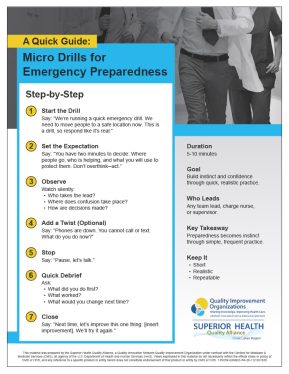
Halvorson used eye-catching colors that match Superior Health’s logo. She also used numbered steps, separate spaces for different information, and short, concise language.
Nursing home staff and other healthcare providers need resources that fit into demanding schedules, particularly when practicing essential but infrequently performed emergency procedures. An easy-to-read graphic helps more people access the material.
Delivering Data
Halvorson uses similar health literacy best practices when communicating healthcare data. For the Behavioral Health Connect (BH Connect) annual report, she organized program information, needs assessment results, and performance measures into clean graphics and understandable outcomes. She said she liked to “sprinkle in graphics to break up the text and make it easier on the eyes.”
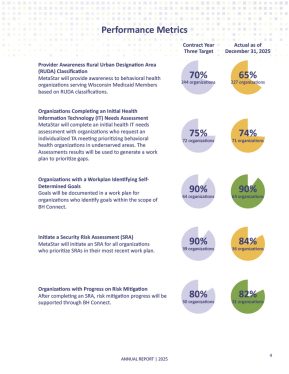
This graphic shows performance metrics three ways: through the image of a pie chart, the color coding of the pie chart, and the percentage in text on the pie chart.
Graphics, like charts, help readers identify important findings without relying solely on paragraphs of text. Often, a clear graphic can convey just as much information as a full page of text—or more. This method is particularly helpful to healthcare quality improvement work. Often, organizations must interpret performance measures, identify opportunities for improvement, and communicate findings to stakeholders with different levels of technical expertise. Having a quick way to do that saves everyone time.
Looking at Logos
Halvorson also connects ideas through logos and other images. These images often communicate ideas in a different way, allowing information to be accessible in multiple modalities. For BH Connect’s logo, she incorporated cellular phone signal bars to represent the program’s focus on health information technology. She also made the “connection” themes visual by connecting the “C” and “O.” The logo communicates the idea of a technology-based program. The program’s focus prepares readers for the rest of the information.
For the Wisconsin Initiative for Long-Term Care Quality Advancement and Leadership (WiLQAL), she combined Wisconsin’s outline with different mobility abilities moving forward. This communicates the program’s goal of moving the quality of long-term care forward.
“She’s really good at visual storytelling,” Altermatt said. Visual storytelling helps provide another avenue for accessing healthcare improvement information.
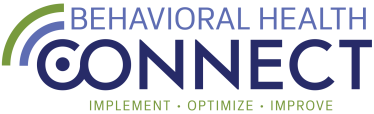
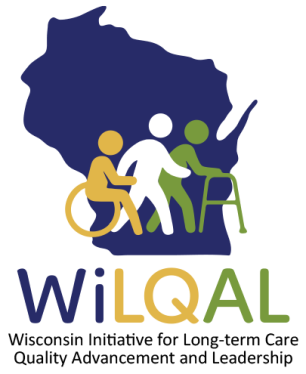
Halvorson incorporated elements of each program’s identity and purpose into its logo.
Rather than just being a splash of color and words, these logos immediately communicate an idea. The logos help preview the content for the reader. They can then better understand whether it is relevant to them.
Leveraging Language and Literacy
The creation of usable resources and the graphics that enhance them are only two parts of the effective communication the team creates. The words themselves must also meet the audience’s needs, whether they are patients unfamiliar with medical jargon or new employees learning on the job.
“We try to use plain language,” Altermatt said.
Plain language emphasizes familiar words, clear organization, and direct writing. It doesn’t mean eliminating necessary information or oversimplifying a message. Instead, it makes the information easier to understand and use.
“Aha Media, a national healthcare communications firm, did a study in 2023, and 80% of those surveyed preferred plain language when presented with various types of content,” Altermatt explained.
Acronyms offer a simple example. Healthcare professionals regularly encounter abbreviations for diagnoses, programs, measures, agencies, and initiatives. However, expertise varies from person to person and from role to role.
“I had to remind the quality improvement advisors that I work with that I don’t see and use these acronyms every day, despite working in healthcare quality improvement,” Halvorson said. “It was kind of an ‘aha’ moment for them.”
Altermatt recommends spelling out acronyms on the first reference, even when addressing experienced professionals. Staff turnover and differences in training can make it difficult to predict what the intended audience knows.
Plain language also supports health literacy and helps reduce avoidable misunderstandings. For organizations implementing quality improvement initiatives, understandable instructions can make it easier for healthcare workers to apply recommended practices.
Including Accessibility
The Improvement in Action: Tornado Response team made accessibility for all people a priority from the beginning. It influenced the team’s choice of platform and how they developed its content.
“The piece is accessible for people who use screen readers, people who use keyboard controls, and people who need closed captioning,” Altermatt explained. These features aren’t just limited to those with impairments. Captions, for example, may be helpful in noisy environments or when listening to audio isn’t practical. “It’s just a different way to access and absorb the information,” Altermatt explained. “It just makes it easier for everyone.”
In healthcare quality improvement, providing information is only the first step. A good communications team must also consider whether their intended audience can easily access and use what is provided.
Connecting Information to Improvement
More than just providing information, the Communications team helps connect information with the people who need it. As Altermatt explained, part of the Communications team’s role is to “help make things understandable and usable.” For healthcare quality improvement, that’s an important distinction. Information can support improvement only when the people responsible for improving care can access, understand, and apply it. For Altermatt and Halvorson, connecting the dots means more than delivering a message. It means helping information become a resource for improvement.
Starring…
Sarah Altermatt, MetaStar’s Marketing and Communications Lead, has been with the company for almost 10 years. She tries to keep two things at the center of her work: What are we trying to accomplish, and what does the end user need? Those questions guide most of the decisions she makes about writing, design, resource development, and all other projects she works on. The fun part is using creativity and connections to create the path to the final product.
Katie Halvorson, a Senior Marketing and Communications Specialist, has spent the past three years advancing MetaStar’s communications efforts, building on more than a decade of experience. With a keen eye for detail and a passion for making everything she touches both polished and aesthetically engaging, Katie strives to create work that is as effective as it is visually compelling.
Kate Schultz is a freelance writer, standardized patient, and cat adoption and resource center volunteer. She strives to make her work as accessible as possible. Even as a former English teacher, she tries not to focus too much on grammar. Instead, she focuses on getting her message across in the clearest, most appropriate way possible. She appreciates the help of communications professionals like Katie and Sarah who help make her work the best it can be.