January 21, 2026
With the barrage of ads, articles, and unwanted advice extolling the benefits of self-improvement at the beginning of a new year, we decided to give self-care the spotlight this month. We spoke with Mia Croyle, MA, Behavioral Health Project Specialist in MetaStar’s Healthcare Transformation department, who explained, “Self-care has become another thing thrown at us when we’re already stressed, and then suddenly it’s time to think about self-improvement.”
However, self-care doesn’t have to be another form of societal pressure disguised as self-improvement. Self-care is much simpler and more meaningful, Croyle explained. “Self-care is about looking after ourselves as we would any loved one,” she said.
Rather than focusing on perfection or transformation, true self-care asks a different question: What do I need right now to support my well-being, resilience, and capacity to keep going?
Moving Beyond Bubble Baths
“Self-care often gets treated as self-indulgent or frivolous,” Croyle said. “Go get a pedicure, or I gave you bath bombs—why aren’t you doing self-care?” While spa days, vacations, and a night out can be restorative, they’re only a small piece of a larger picture. Meaningful self-care often looks quieter and less glamorous. It can involve reflection, boundary-setting, and making choices that support long-term well-being, even when they’re uncomfortable.
Additionally, self-care can also look like doing things you’re already doing but with more intention. For example, Croyle turned grocery shopping into an act of self-care when she chose ingredients for a nourishing and enjoyable meal for herself rather than resorting to whatever leftovers from her kids’ meals happened to be in the fridge. The activities of grocery shopping and eating a meal remained. The intention behind them changed, and they became acts of self-care.
Croyle uses a simple framework, CARE, to make this broader, more sustainable vision of self-care easier to remember and practice. CARE stands for Connect, Attend, Restore, and Engage.
C is for Connect
As humans, we’re wired for connection, but not all connections are equally nourishing. Self-care begins by asking ourselves, “What kind of connection am I missing right now, and how can I meet that need in a positive way?”
For some people, connection is a deep conversation with a trusted friend. For others, it’s being around other people without needing to interact. Croyle shared an example of a friend who visits a quiet coffee shop to read. “She likes being physically in the presence of others without having to engage,” Croyle said. “It’s such a self-aware way of meeting her need for connection.”
Connection can also mean connecting with yourself: journaling, spending time alone, or simply checking in on how you’re feeling. Ask yourself what connections are meaningful, Croyle recommended, and which ones make you feel seen, valued, and heard.
A is for Attention
Self-care requires noticing what’s happening inside us. “It starts with paying attention to ourselves,” Croyle explained, “and then cultivating self-care practices alongside that attention.” Noticing emotions, tensions, and unmet needs will drive the types of activities that provide fulfilling self-care. “It’s not about shaming yourself,” Croyle added. “It’s about acknowledging that you have an unmet need right now.”
Practices like meditation, visualization, or grounding exercises can support this awareness, especially for people who don’t find it easy to slow down and pay attention to their internal state, emotions, and needs.
Awareness sometimes reveals gaps between how we’re living and what we actually need. “That discomfort can be part of self-care,” Croyle noted. Growth doesn’t always feel like a warm hug, but putting in the work helps us become better caregivers to ourselves.
Sometimes, simply naming a need is enough. You might not have the capacity to address it immediately. Honoring the need still matters, explained Croyle, and allows you to make plans to meet it in the future.
R is for Restore
Much of the core of self-care is about restoration. It’s about repairing the “little broken bits” that accumulate when we’ve given too much or ignored our limits. “Self-care can be about restoring those places,” Croyle said.
Creating a physical space for restoration can help. That space doesn’t have to be elaborate. It could be a favorite chair with a soft blanket, a window seat with morning light, or a particular bench at the park. Restorative spaces can be paired with other practices—breathing exercises, journaling, or joyful movement, like dancing in the kitchen. “It’s not just the act of creating a restorative space,” Croyle explained. “It’s saying, ‘I’m doing this for myself.’” The goal is not productivity or perfection but restoration.
E is for Engage
Engagement is about being fully present when doing things that spark joy, curiosity, or meaning. “It might be a hobby,” Croyle said, “or watching something funny, or engaging in prayer or journaling.” Engagement can be light or deeply meaningful; both count because the key is being present. You aren’t multitasking, thinking about other things you need to do, or squeezing it in as an afterthought. You’re engaging in some kind of connection on purpose, with attention, to restore and care for yourself.
A Bit About Boundaries
A common thread unites all four elements of CARE: self-awareness. Self-awareness allows you to say, “If I don’t take a pause here,” Croyle explained, “I’m not going to be able to keep giving to others.” It then becomes possible to set boundaries around work, energy, and time, not as an act of selfishness, but as an act of sustainability. Many of us assume we’re an endless source of care, but even the most generous reserves run out eventually.
Boundaries don’t have to be dramatic, severe, or announced. Setting boundaries might look like asking to join a meeting by phone instead of video, going to the gym for a shorter (or longer) time, or bringing store-bought cookies instead of homemade. Everyone still gets fed, and no one gets burned out.
Learning and respecting your limits in order to care for yourself builds self-worth over time. That self-worth allows you to see your time, energy, and efforts are just as important as anyone else’s. It allows you to protect and utilize your resources in purposeful ways, like learning to say “no” even if you really want to say “yes.” And it allows you to keep showing up as your full, authentic self rather than a depleted version of you.
Big Rocks Come First
Self-care asks us to see ourselves as essential, not an afterthought. Croyle referenced the classic “big rocks” analogy from The Seven Habits of Highly Effective People by Stephen Covey: if you don’t put the big rocks into the jar first, they won’t fit later once the gravel, sand, and water have been added.
Too often, we treat ourselves as the container rather than one of the most important rocks.
As a new year begins, self-care doesn’t have to be another resolution forgotten by February. It can be a small, intentional practice that helps us meet this year as we are. That is a meaningful place to start.
Starring…
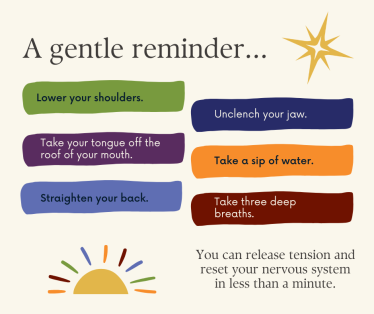
Mia Croyle has worked at MetaStar for seven years. The graphic in the article describes her favorite self-care activity. She keeps it posted by her desk as a reminder that self-care doesn’t need to be complicated, and it helps her multiple times per day.
Kate Schultz is a freelance writer who used to be a high school English teacher, stage manager, and software tester. Her favorite self-care activity involves a warm blanket, a quiet room, a delicious snack, and a friendly cat to cuddle with.